

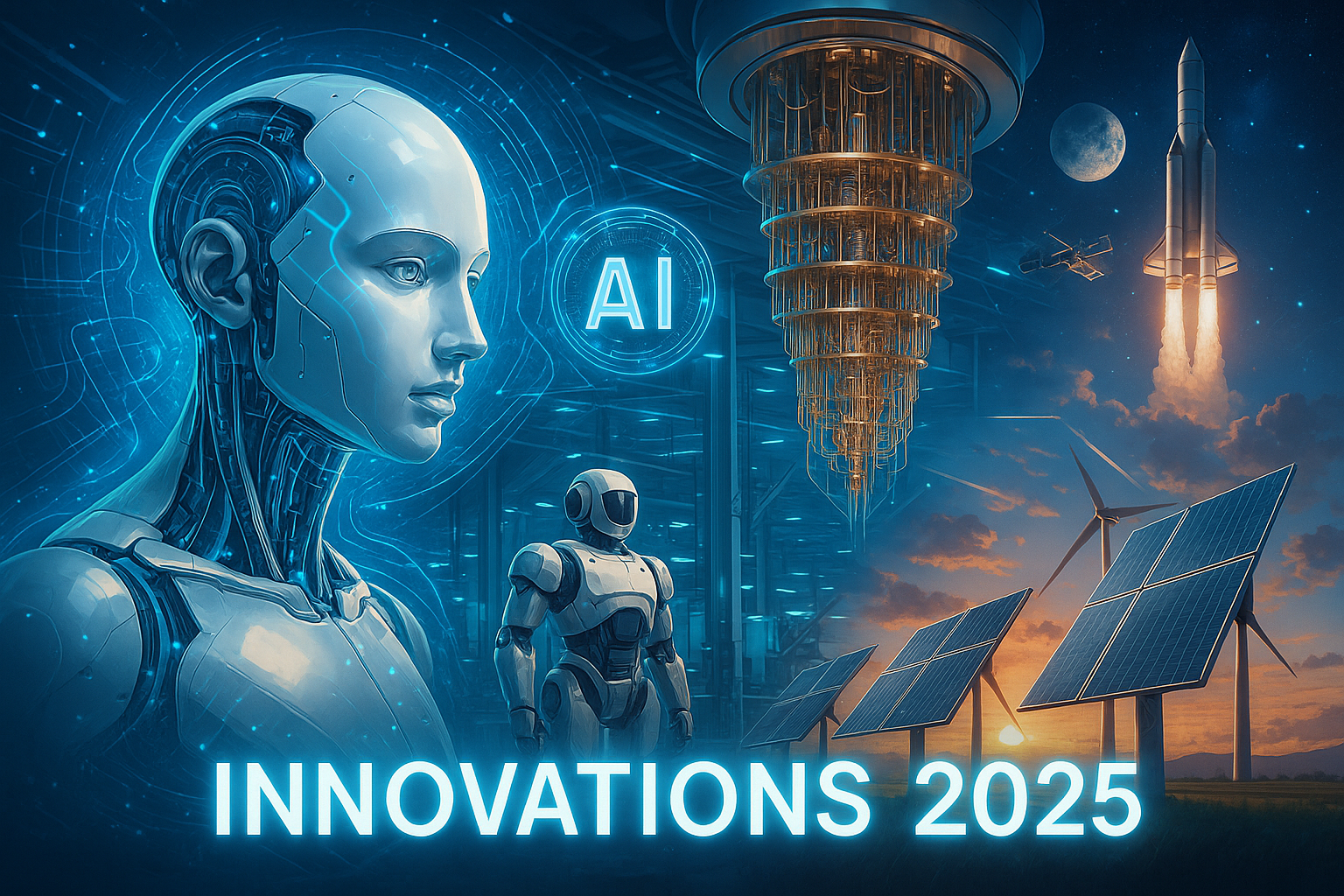
Introduction
The world is entering a new era of technological and scientific advancements.
Breakthrough innovations are redefining industries, lifestyles, and global connectivity.
This blog explores key innovations that will shape 2025 and the years beyond.
1. Artificial Intelligence & Machine Learning
- AI continues to automate complex tasks and improve decision-making
- Applications in healthcare, finance, logistics, and creative industries
- AI-driven personalization for products, services, and learning
Impact: Enhances efficiency, creativity, and problem-solving across sectors.
2. Quantum Computing
- Next-generation computing with massive data processing power
- Potential breakthroughs in cryptography, medicine, and climate modeling
- Solves problems impossible for classical computers
Impact: Revolutionizes research, data analysis, and technology development.
3. Renewable Energy & Clean Tech
- Advances in solar, wind, and hydrogen energy
- Energy storage innovations like high-capacity batteries
- Sustainable solutions reducing carbon footprint
Impact: Accelerates global transition to sustainable energy and combats climate change.
4. Biotechnology & Gene Editing
- CRISPR and genetic engineering for treating diseases
- Personalized medicine and regenerative therapies
- Innovations in agriculture and food production
Impact: Improves health outcomes and supports sustainable food systems.
5. Autonomous Vehicles & Drones
- Self-driving cars, trucks, and flying taxis
- Drone delivery and surveillance technology
- Safer, faster, and more efficient transportation systems
Impact: Redefines mobility, logistics, and urban infrastructure.
6. Virtual Reality (VR) & Augmented Reality (AR)
- Immersive experiences for gaming, education, and training
- AR enhances real-world interactions with layered digital information
- Applications in remote work, healthcare, and design
Impact: Transforms entertainment, learning, and professional collaboration.
7. Space Exploration & Commercialization
- Private companies and governments advancing space travel
- Lunar bases, asteroid mining, and satellite networks
- Expanding opportunities for research, tourism, and communication
Impact: Opens new frontiers for science, economy, and technology.
8. Advanced Robotics & Automation
- Intelligent robots performing complex tasks in factories and homes
- Collaborative robots (cobots) working alongside humans
- Automation in healthcare, logistics, and service industries
Impact: Enhances productivity, safety, and efficiency across sectors.
9. Internet of Things (IoT) & Smart Cities
- Connected devices for homes, offices, and urban infrastructure
- Real-time monitoring, predictive maintenance, and data-driven services
- Smart grids, traffic management, and public safety solutions
Impact: Creates efficient, sustainable, and responsive urban environments.
10. 5G & Next-Generation Connectivity
- Ultra-fast mobile networks enabling real-time data and AI applications
- Supports IoT, remote surgery, autonomous vehicles, and immersive media
- Connects communities globally with minimal latency
Impact: Powers innovation and enhances digital experiences worldwide.
Conclusion
Breakthrough innovations are reshaping industries, daily life, and global opportunities.
Key takeaways:
- AI, quantum computing, and biotechnology will revolutionize health, work, and research
- Renewable energy, autonomous vehicles, and robotics improve sustainability and efficiency
- VR/AR, IoT, and 5G will redefine communication, learning, and urban living
By staying informed and adapting to these innovations, individuals and businesses can thrive in the fast-evolving world of 2025 and beyond.